Monday, 10 February 2014

In defence of ‘trends’


I don’t have a problem with people reporting ‘trends’. There, I’ve said it now so I can’t take it back. I see a lot of tweets highlighting research papers reporting non-significant ‘trends’. For example, someone might write in their results section “our comparison of interest was marginally significant (p=.08)”. So how bad is it to say something like this instead of “our comparison of interest wasn’t significant (p=.08)”? My argument is it depends on the circumstances and the exact wording. This isn’t to defend dodgy statistical practices, but just to add a bit more nuance rather than vilifying anyone who reports ‘trends’.

So, when is it definitely bad? When you want an effect to be there, you bend over backward and report one-tailed p-values, then report a ‘marginal’ effect, and finally make conclusions based on that ‘effect’. This situation undoubtedly applies to a lot of cases and is clearly the wrong way to go about doing things. Perhaps more contentious though: when is it OK to report a ‘trend’? Well, I would argue that as long as you are upfront about whether an effect is significant or not, and you are consistent in the manner in which you report it, it is OK to bring attention to the fact that a certain contrast revealed a ‘trend’.

For example, say I have run 3 experiments. Each experiment has four conditions in a 2x2 factorial design [A1B1 A2B1 A1B2 A2B2]. In all three experiments I see a significant difference between A1 and A2 in condition B1, but not in B2. Great, all three experiments agree with each other! In Experiments 1-2, I also see a significant interaction between these two factors. In other words, the difference between A1 and A2 in condition B1 is greater than the difference between A1 and A2 in condition B2. Great, everyone likes an interaction. However, in Experiment 3, the interaction doesn’t quite reach significance (p=.06). In such a situation I don’t see an issue with saying “the interaction term didn’t reach significance (though we note a trend in line with Experiments 1-2)”*. Some might disagree, but in my view as long as you are upfront about what you are reporting then the reader is at liberty to decide for themselves whether to ‘believe’ your results or not.
 
If you do disagree, the fact remains that the use of the word ‘trend’ is probably here to stay. So with that in mind, I’ve tried to come up with some suggestions that should hopefully bring clarity if people decide they do want to use the dirty word:

  1. State first and foremost that the effect is not significant – it isn’t, get over it.
  2.  State clearly what you think a ‘trend’ is, ahead of time. For example, any two-tailed p-value between .05 and .08.
  3. Apply this criterion to all contrasts, whether it is a contrast you predicted would be significant or not. If you think ‘trends’ are worth bringing attention to, this applies equally to effects you might not be as interested in or you didn’t predict would be significant.
  4. Don’t draw conclusions from any ‘trends’ unless they are supported by further evidence – as in the example I outlined above.

In this way all you are doing is bringing attention to particular non-significant p-values in a consistent non-biased manner. I’m guessing there will be some who disagree with this type of approach. I’d be interested to hear people’s views regardless.

* Actually, in this situation you could run a mixed-ANOVA to compare the interaction term across experiments. If you find a significant interaction between A and B, that didn’t further interact with the between-subject factor ‘Experiment’, then everyone is happy.

Tuesday, 26 November 2013

Research Briefing: The associative structure of memory for multi-element events


Inspired by Chris Chambers and Mark Stokes, this is a research briefing about a recent paper published by myself and Neil Burgess. My hope is that it explains why we did the research, what we found, and why we feel this is important. As with the research briefings from the names above, it is aimed at a scientifically-curious individual without any prior knowledge in the subject. In relation to this, I hope I pitch it correctly – do let me know one way or the other!

Horner, A.J., & Burgess, N. (2013) The associative structure of memory for multi-element events, Journal of Experimental Psychology: General, 142(4), 1370-1383. [abstract & PDF]

When we remember previous events in our lives we bring to mind a wealth of information. We remember the layout of the living-room, the person we were talking to, the music that was playing in the background and the smell that wafted through from the kitchen. When we first experienced this event, each element within this multi-sensory experience was processed in different regions of the brain. For example, the visual information will have been processed in visual cortex in the occipital and temporal lobes and the auditory information in auditory cortex in the temporal lobes. How is it that we are able to remember all these multiple elements despite them being processed in different regions of the brain? 

Theories of episodic memory (memory for events) suggest that all the multiple elements of an event are bound together in an ‘event’ memory (or, more precisely, and event ‘engram’ or event ‘memory trace’) [1]. By binding all this information into a single engram, all the elements from an event can be retrieved and re-experienced at a later time. The hippocampi, located in the temporal lobes, are thought to support this binding as they receive input from multiple regions of the cortex. In this sense, they act as ‘convergence zones’, binding information across our multiple senses [2].

Although most theories of episodic memory presume the existence of bound event engrams, little evidence has been presented in support of this idea [though see 3]. One prediction that stems from this proposal is that the retrieval of elements from the same event should be related. If you retrieve information about the location you were in, you should be more likely to retrieve information about who was there and what they were saying at the time. In other words, retrieval of an event should be ‘all-or-none’ in nature. We tested this prediction, providing support for the existence of bound event engrams.


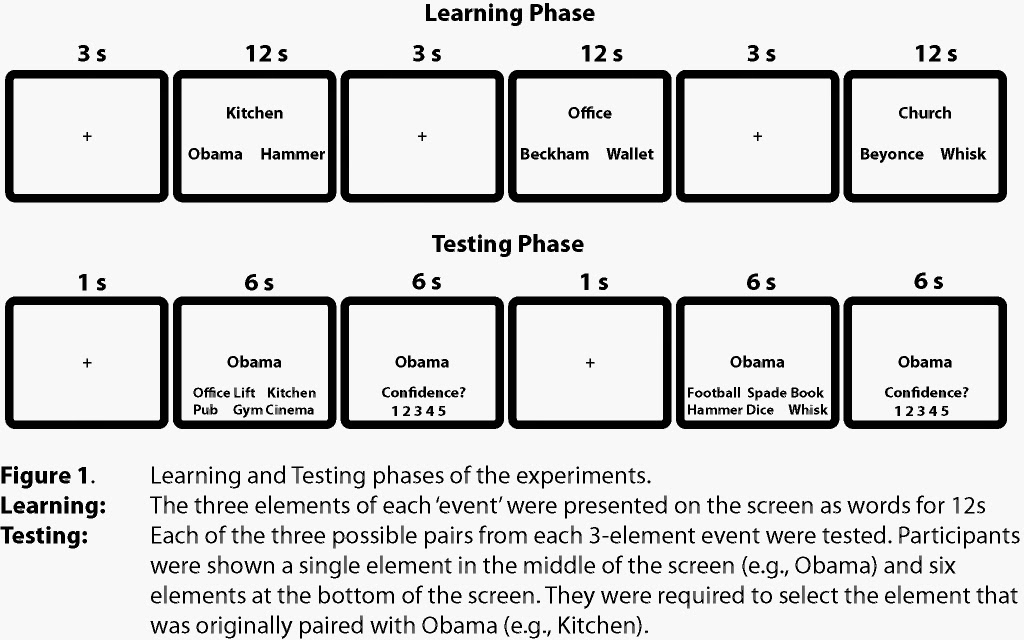
The experiments consisted of a learning and a testing phase (Figure 1). During learning, participants were presented with a series of ‘events’. Each event consisted of three elements – a location, famous person and object. For example, an event might be: Kitchen, Barack Obama and Hammer. The three elements of each event were presented on a computer screen, as words. Participants were required to construct a mental image of the three elements interacting and imagine it as vividly as possible. For example, they might imagine Barack Obama smashing kitchen cupboards with a hammer. After learning several events we tested their memory for each pairwise association within each three element event. In the above example, this meant testing the association between Kitchen and Barack Obama; Kitchen and Hammer; and Barack Obama and Hammer. 

If all three elements of an event are bound in a single event engram, performance for each pair should be related. If you remember Kitchen and Barack Obama, you should also remember Kitchen and Hammer. Equally, if you don’t remember one pair, you shouldn’t remember the other pairs from the same event. We tested this ‘dependency’ between retrievals from the same event. In order to control for differences in accuracy and the level of guessing across participants, we developed models that predicted the level of dependency if performance of pairs for an event were unrelated (the Independent Model) or if performance of pairs for an event were completely related (the Dependent Model). We then compared the amount of dependency for each participant with each of these models to see if the retrieval of elements from the same event were related. Across three experiments we showed strong evidence for this predicted dependency. The level of dependency was consistently greater than the Independent Model (Figure 2), and in some situations did not differ from the Dependent Model (see paper).

Thus, we provided evidence that the multiple elements of an event are bound within a single ‘event’ engram. Event engrams are thought to be the fundamental building blocks of episodic memory. They allow us to retrieve information about a single event, without retrieving information from other similar events. Despite the common assumption that these event engrams exist, we provide some of the first behavioural evidence for their existence. Our future work is focussing on revealing the exact neural mechanism that allows for this event binding, as well as investigating which regions of the brain support this binding process.
 

  1. Tulving, E. (1983). Elements of episodic memory. Oxford: Clarendon Press.
  2. Damasio, A. R. (1989). The Brain Binds Entities and Events by Multiregional Activation from Convergence Zones. Neural Computation, 1(1), 123–132.
  3. Jones, G. V. (1976). A fragmentation hypothesis of memory: Cued recall of pictures and of sequential position. Journal of Experimental Psychology: General, 105(3), 277–293.